Case A - Simple, uninterrupted downlink
4 images queued for pass 1, no interrupt. Baseline case. constructed
Setup / assumptions
- 4 images, sent as 4 separate transfers (labeled Tx1-Tx4 - "Tx" = "transaction," CFDP's term for one file transfer). Splitting big images into several transfers instead is still open - Q8.
- CFDP's reliable mode ("Class 2 / Acknowledged") - confirmed with PAVI. The satellite gets confirmation each image arrived, and can resend missing pieces if needed.
- Sent one at a time, Tx1→Tx2→Tx3→Tx4 - deliberate, not just tidiness (why, below).
- PLDP doesn't process live. It records during the pass, and only decodes/checks afterward, once the pass ends ("LOS" = Loss Of Signal).
How these 4 images got decided for Pass 1 in the first place is now shown in the diagram below, at PPS's downlink-request step - PPS's mechanism, worked out later in this project (see the TC vs X-band concept, Q23): a request travels up as a custom command, and the satellite's payload app locally issues each Put.request from it. Still a light, unconfirmed working assumption, not locked - noted here since this is the first case where the gap actually shows up.
Phase 1 - Sending during Pass 1
The satellite sends all 4 images, one after another. Each image goes out as three messages in order: "here's what's coming" (Metadata), the image data itself (File Data), and "that's everything, here's the checksum" (EOF).
Nothing complicated here - no pausing, no resending. The smooth, ideal case.
Pass ends (LOS). Everything sent is sitting in PLDP's raw recording, but nothing's been decoded or checked yet.
Phase 2 - Ground-side processing, then Pass 2's S-band uplink
PLDP decodes the pass-1 recording, reassembles all 4 images, checks each checksum - all clean. PLDP does not wait for all 4 before acting: each image's confirmation is handed off to MCS the moment that image individually validates - Image 1 first, then 2, and so on, independent of how long Image 4 takes.
PLDP sends two confirmations per image: "got your EOF" (ACK(EOF)) and "complete and correct" (Finished(complete)). PLDP can't talk to the satellite directly, so these travel to MCS first, then ride up on Pass 2's S-band window - S-band and X-band are up together on every pass, so this doesn't need a separate dedicated contact.
Why dispatch immediately instead of batching everything?
Two separate layers were getting blurred together here - worth pulling apart:
- PLDP's dispatch policy - hand each image's confirmation off the moment it validates. Never wait on a slower sibling.
- MCS's transmission policy - when Pass 2's S-band window opens, MCS batches whatever's sitting in its queue at that moment into one frame (see below). This happens naturally, regardless of how PLDP dispatched - it isn't something PLDP has to orchestrate.
Result: Images 1-3, ready by the time Pass 2's window opens, go up together in one frame. Image 4, not ready yet, simply isn't in the queue at that moment - it rides whatever later window it's actually ready for. Nobody waits artificially, and nothing gets sent as a wasted lone transmission if something else happens to be ready alongside it. This gets full transmission-count efficiency (the same COP-1/CLCW round-trip argument that would apply if MCS runs something like YAMCS) with none of the downside of an artificial wait - and it matches how CFDP is already built to treat every transfer as independent.
Still open: whether MCS's actual per-transmission cost (COP-1 round trips, command queue gating, rate limits) is large enough to matter in practice - doesn't change this design, just how much it was worth reasoning through. Worth confirming with whoever operates MCS.
Phase 3 - Same Pass 2, the satellite confirms receipt
The satellite acknowledges each Finished message as it individually arrives and gets processed (ACK(Finished)), rather than waiting for all 4 - Image 1 can be fully closed while Image 4 is still processing. This travels back down via X-band, still within Pass 2, since X-band is co-active with the S-band uplink that just happened. No third pass needed.
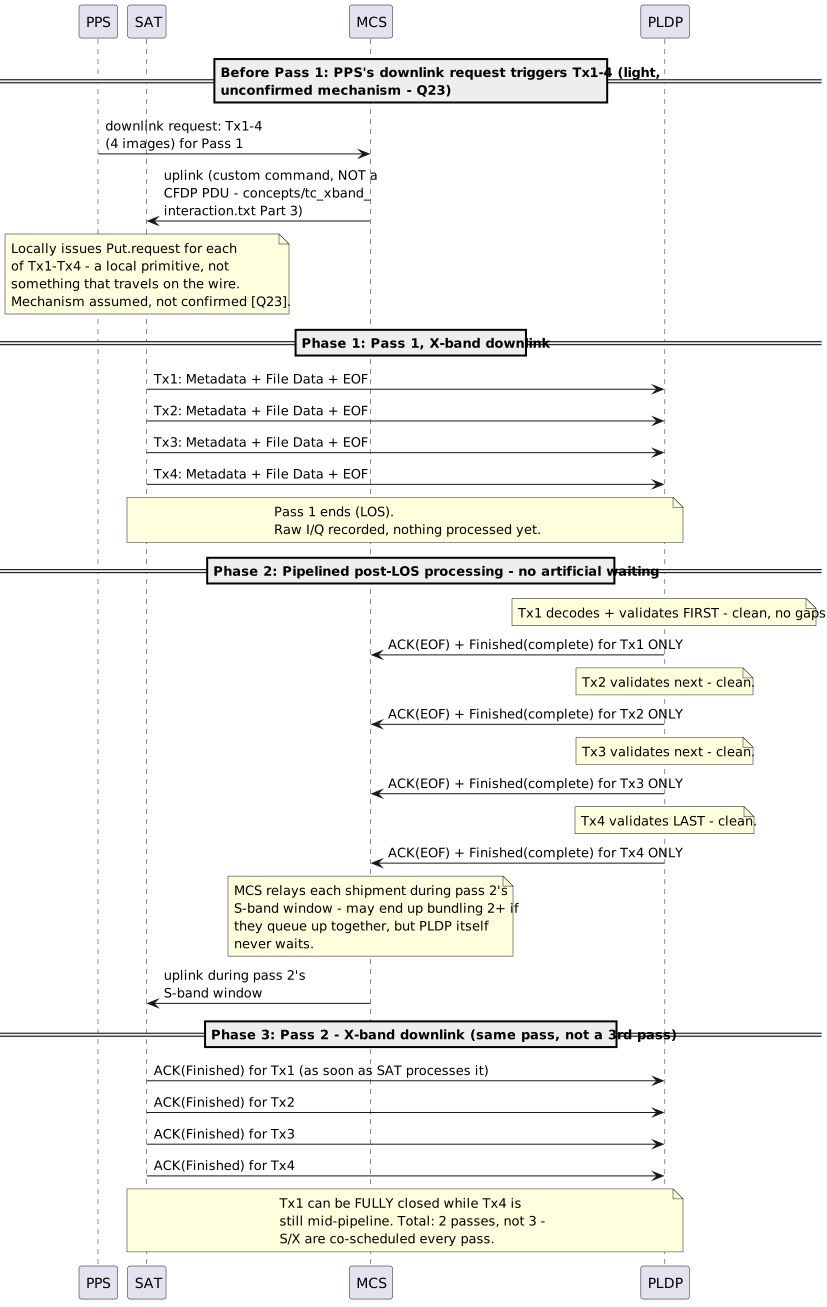
Rendered from diagram/case_a_closure.puml (PlantUML)
Variant - what if the pass ends mid-way through the last image?
Suppose Pass 1 is barely too short for all 4 - Images 1-3 finish cleanly, but LOS hits mid-way through Image 4. The design above already handles this with no special case:
- Images 1-3: fully received, no problems → send their confirmations at the next chance, without waiting on Image 4.
- Image 4: incomplete, needs Pass 2 to finish, then goes through its own confirmation cycle separately.
This works because CFDP treats every transfer independently - 3 of 4 images can be wrapped up a whole pass earlier than the 4th.
The one thing worth remembering
Even in this best case, fully closing out all 4 transfers takes two passes (Pass 1 for the original send, Pass 2 for the complete uplink+downlink confirmation round trip). It's two, not three, specifically because S-band and X-band are up together on every pass: the confirmations ride Pass 2's S-band up, and the satellite's reply rides that same Pass 2's X-band down. But as noted above, the image itself is usable much sooner, right after Phase 2's checksum check. Don't confuse "not yet closed" with "not yet usable."