Concept: TC uplink vs X-band downlink - how they interact (and mostly don't)
Used in: Case C directly (large image, multi-pass delivery - Tiling and Pause/Resume candidates); Part 3 below also underlies how any downlink transaction in ANY case gets initiated at all (light, unconfirmed - relevant everywhere, not just Case C)
Part 1 - The pure fundamental mechanic
Both TC and TM/AOS are defined the same way at the physical-channel level: a Physical Channel is "a stream of bits transferred over a space link in a single direction." There's no "duplex channel" concept anywhere in either spec - each direction is its own separate channel by definition. TC and TM/AOS are structurally independent: the downlink specs don't even reference uplink activity, beyond one cursory note that TC and TM Transfer Frames are distinguishable by their sync marker/start sequence - a bit-pattern disambiguation, not a functional relationship.
Within TC itself, multiplexing (Virtual Channels / MAP Channels) lets one TC Physical Channel carry multiple logical streams, but CCSDS explicitly leaves ordering/priority among them to "project organizations considering factors such as priority, release rate, isochronous timing requirements" - not CCSDS-mandated. Same pattern as CFDP's own flow-label parameter (see the NAK Timer concept's sibling finding from the Case C research): the spec repeatedly leaves scheduling/ordering policy to the implementation, not the protocol.
Part 2 - Applied to our setup
Per fact.txt: S-band is the bidirectional TM/TC channel, X-band is downlink-only for payload data, and both are co-scheduled (active together every pass). Combining that with Part 1's finding: if COP-1 is in use, CLCW rides back via S-band TM - not X-band. This means X-band's payload downlink is mechanically untouched by TC uplink activity, full stop, regardless of how busy the TC link gets during a pass. The two are genuinely separate RF paths and separate onboard processing chains - the only "interaction" between them is that they happen to share the same pass window, not any transmission-level contention.
Case C's actual need (revised)
An earlier version of this concept assumed ground would command "only send byte range X-Y this pass," requiring a custom byte-range instruction. A real team discussion (see Case C) showed that's not actually what's being proposed - the two real candidates are lighter than that:
- Tiling: ground's downlink request just needs to name multiple files (tiles) and which pass each is assigned to - no byte-range parameter needed at all, just ordinary Put.request targeting, repeated per tile. A direct extension of Part 3 below, not a new mechanism.
- Pause/Resume: ground needs to signal Suspend/Resume for a single transaction - timing only (when), never which bytes, since CFDP's own Suspend/Resume primitives have no byte-range parameter at all.
Routing - for whichever candidate
The downlink-request-naming-files case (Tiling) rides the same plain-command path as Part 3 below - an ordinary PUS command through the standard command processor, not the reserved CFDP-uplink APID, since it's not a CFDP PDU. The Suspend/Resume signaling case (Pause/Resume) is different: CFDP actually does define native Remote Suspend/Resume Request messages for exactly this purpose - so ground has an actual choice there (unlike the byte-range idea, which had no CFDP-native equivalent at all): use CFDP's own Remote Suspend/Resume Request-Response mechanism (2 extra Class-2 transactions per pause/resume), or a cheaper plain command on the same ordinary-PUS-APID pattern as everything else here. This is exactly Q7.12, already tracked - Case C's Pause/Resume candidate is what makes it directly load-bearing now.
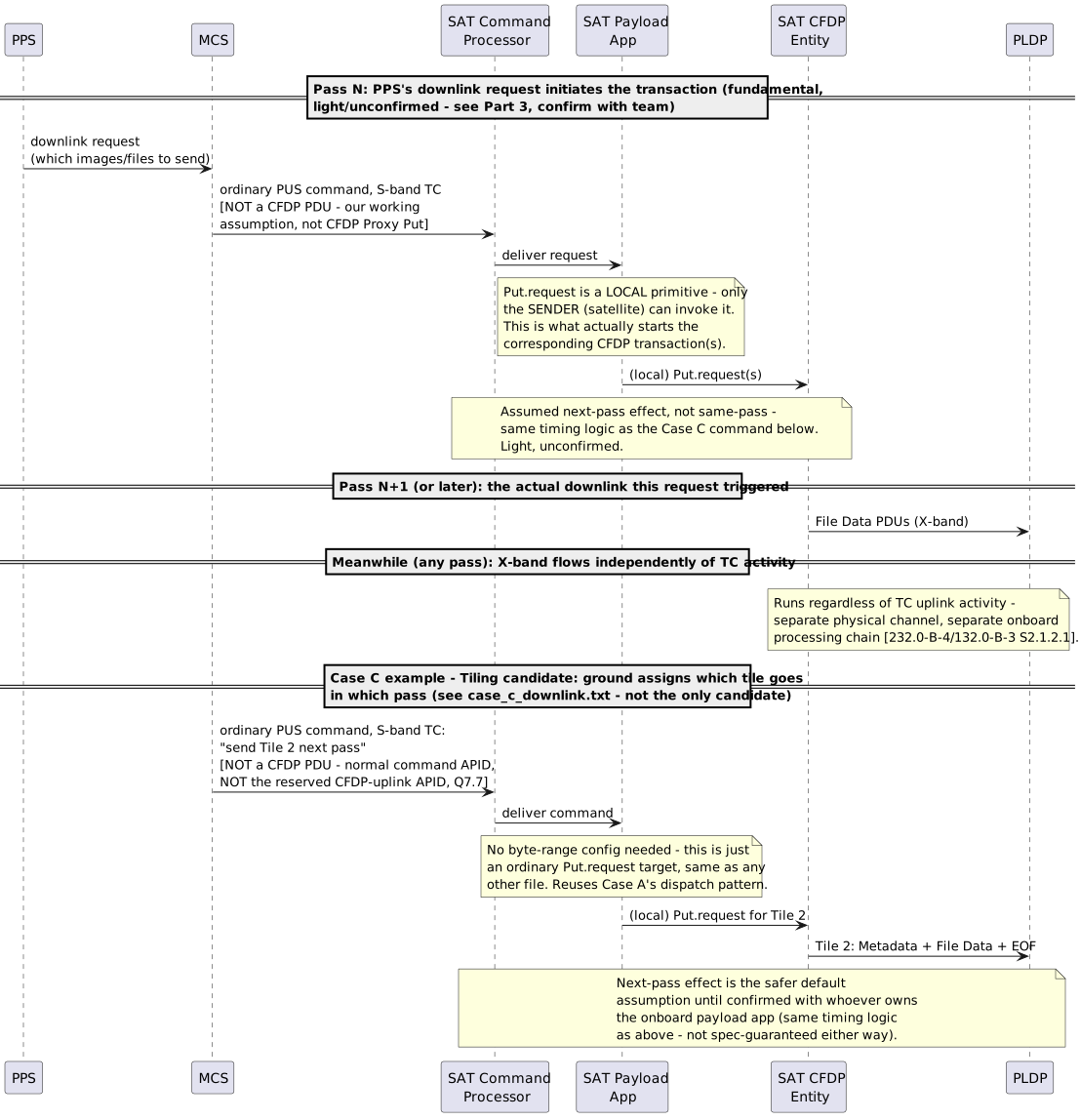
Rendered from diagram/tc_xband_routing.puml (PlantUML)
Timing - same pass, or the next one?
S-band being live throughout the pass means the command bits could physically arrive in time, but CCSDS defines no processing-latency bound for command-to-action time onboard - that's entirely implementation-specific onboard software behavior, outside what any of these specs govern. Consistent with this project's other post-LOS-driven latency patterns (NAK routing, pause/resume), the safer assumption is next-pass effect, not same-pass, for either candidate's command - treat same-pass effect as a possible optimization to confirm with whoever owns the onboard payload app, not a default.
Part 3 - The more fundamental case: how a downlink even gets initiated (light, unconfirmed - confirm with team)
Part 2 covers refining an already-running large-image transaction's schedule. There's a more basic question underneath it, which this project has been assuming rather than stating explicitly: how does a downlink transaction get started at all? In CFDP, Put.request is a local primitive - only the entity acting as sender can invoke it to start a transaction. In our architecture the satellite is always the sender (it's the one with the file to send), so ground can never directly call Put itself - it can only get the satellite to call Put on ground's behalf, somehow.
Rendered from diagram/tc_xband_routing.puml (PlantUML)
Timing - same logic as Part 2, probably even more solidly: a downlink request uplinked during Pass N most likely can't result in File Data flowing in that same pass N - realistically it takes effect starting Pass N+1 or whichever later pass the schedule assigns it to. This matches every other "ground input → next opportunity" pattern already found elsewhere in this project (NAK routing, pause/resume, Part 2's byte-range command) - it would be surprising if this one command behaved differently.
Keep this light: this is this project's own working assumption about how the architecture fits together, not something confirmed with whoever owns PPS or the onboard payload app. Treat it as very likely correct, but flagged for actual team confirmation, not locked as fact.